There comes a time where all good things must come to an end. Today is such a day.
A day where my blog and I must say goodbye.
Writing and managing a blog has been such an experience. There's a sense of calm in organizing your thoughts all in one place. A permanency in putting them somewhere you can come back to. A reach across time and space to touch people you may not have even met.
I started this blog thinking it would simply be a place to put my thoughts, but it has become even more. It has let me think about these thoughts, tie them to the thoughts of my peers, the thoughts of the web, the thoughts of society. There's such a world out there, and to think that the things you write can be read by them is such an amazing thing. A hopeful thing. Words matter. Ideas matter. And we have the gift to give them to the world.
I hope that you have enjoyed reading and thinking about the world and the way we explore and communicate within it.
Stay connected,
Patti
Friday, December 6, 2013

Thursday, November 14, 2013
plz mind ur ps n qs
The internet is a wide and scary place, full of flamers and creepers and trolls, oh my! But there's one way you can make the web a safer, and nicer, place for everyone-- "netiquette."
"Netiquette," as the word implies, refers to the etiquette of the net. A set of guidelines that are used when interacting through the internet. Some of these are unspoken. Some are often stated. And many are ignored.
How do we know what personal information to keep hidden? When is it appropriate to "like" a sad Facebook status? Why do we all hate chain mail so much? As we grew up with the internet, the "dos" and "don'ts" of the web itself were absorbed by us rather than taught to us. But, once upon a time, "netiquette" was an important skill to study for a more enjoyable experience of the internet.
Now that the internet is old hat to us, what is acceptable and what is not seems to come as second nature to most of us. Chain mail is annoying to us because it's important to respect other people's inbox spaces. Misspellings are left alone because most internet browsing is done in a casual setting or even in a hurry and that is something we understand. The internet is such a common resource to us that to us, the etiquette of the internet seems like every day etiquette.
But as with all manners, there are lapses.
"noob." "*you're not your, idiot."
There are times when we forget our manners even in real life, but with words appearing as letters and faces hidden behind screens it seems even easier to pretend that we have to be nice to others on the internet. Although, for our generation, the internet has seemingly always been a part of all of our lives, this does not mean that all people view the internet in the same way. For some people, a mean comment made on a video may not mean anything because the time they spend online is completely different from the time they spend offline. However, some of us may not have this separation, and what is said online may hurt offline too. This is why it's important to keep a thought in mind: we are all humans. Although we are using machines to communicate, its thoughts are ours, and the emotions portrayed, and felt, are real.
Because of its wide use, some common knowledge is internalized, but because of the freedom of the medium, others seem to be taken advantage of. The more ways we have to express ourselves, are we having trouble applying etiquette to them? Are we forgetting our manners?
Sunday, November 10, 2013
Duran Duran Plays Second Life?!
I trust you all enough to let you in on a little secret:
I'm a bit of an 80s music dork. And by "a bit," I actually mean quite a lot. I listen to Talking Heads at least once a week, I know mostly all the words to every song by The Police, and Depeche Mode would be my dream concert. Don't even get me started on New Romantic David Bowie.
Anyhow, the reason this is relevant is because I happen to be "friends" with a lot of still-touring 80s bands on Facebook. They often post shout-outs to celebrities, dates of upcoming concerts, and fan-made covers of their songs. But today, one post on Duran Duran's page caught me off guard.
With a little more investigation, I found that not only do the members of Duran Duran play Second Life, they have created their own Second Life universe.
Second Life is an online virtual world where users can interact with one another in real-time using three-dimensional characters called avatars. These avatars can change outfits, genders, or even species. Users can create worlds and open them to the public, creating a virtual hang-out spot for players to dance, chat, and form relationships in. Events and parties are planned, often times even hosting DJs and live music.
Such a large, live virtual community opens up a huge window of opportunity, and Duran Duran took notice of this window. In fact, they took such notice that in 2006 they promised players that a Duran Duran Second Life zone would soon be opened. And so each member of the band joined the site, created their own avatar, and worked to create their own world within Second Life. They called it the "Duran Duran Universe," or the DDU. They meticulously chose everything within their Second Life zone, from the "lipstick tower high in the Azizi sky to the underwater UFO Club in the Sanhedralite sea."
Even years later, they continue to host monthly themed events and have birthday parties for band members where any player is invited to come dance and chat in the name of Duran Duran.
Tonight's party was the previously mentioned Magic Bus Party. Unfortunately, I missed it by a couple of hours, but I would have very much wanted to go. So many questions come from this newly found information. Are the band members actually present at these parties? Do they chat with the fans? Do they DJ their own music during these parties? Or could it all just be one person maintaining the band's Second Life life, keeping them in touch with today's tech-savvy fans?
I had never imagined the internet as a new market for a fan base. Or for a gig venue. But Duran Duran's interaction in Second Life makes the internet seem so much more progressive for groups than I had previously imagined. If book clubs and support groups can grow by becoming virtual, so can a band. They don't need to keep things on the internet to fan-mail and CD sales, they can chat with fans avatar-to-avatar and even perform concerts live through everyone's computer speakers. As Duran Duran says: "Move it in/Move it out/Move up the line." They really are moving up the line in the world, and stepping over the line between physical and virtual. It's amazing-- the more the internet is used for interactions that usually take place face-to-face, the more we're really starting to see this separation between the physical and the virtual world "come undone."
I'm a bit of an 80s music dork. And by "a bit," I actually mean quite a lot. I listen to Talking Heads at least once a week, I know mostly all the words to every song by The Police, and Depeche Mode would be my dream concert. Don't even get me started on New Romantic David Bowie.
Anyhow, the reason this is relevant is because I happen to be "friends" with a lot of still-touring 80s bands on Facebook. They often post shout-outs to celebrities, dates of upcoming concerts, and fan-made covers of their songs. But today, one post on Duran Duran's page caught me off guard.
"Jump on the Magic Bus and party all hippie style with us at the campfire on the Sanhedralite beach Saturday, November 9th, 1 pm SL time (9 pm GMT, 4 pm EST). Come as a soul sister hippie chick or a psychedelic dude in your most beautiful colours! We are going to film the event as always so make sure to join us if you wanna get famous!"Accompanied was a picture of a 3D hippie chick, complete with shaded circle-lens glasses and a crown of daisies. "SL?" Did that stand for... Second Life?
With a little more investigation, I found that not only do the members of Duran Duran play Second Life, they have created their own Second Life universe.
Second Life is an online virtual world where users can interact with one another in real-time using three-dimensional characters called avatars. These avatars can change outfits, genders, or even species. Users can create worlds and open them to the public, creating a virtual hang-out spot for players to dance, chat, and form relationships in. Events and parties are planned, often times even hosting DJs and live music.
Such a large, live virtual community opens up a huge window of opportunity, and Duran Duran took notice of this window. In fact, they took such notice that in 2006 they promised players that a Duran Duran Second Life zone would soon be opened. And so each member of the band joined the site, created their own avatar, and worked to create their own world within Second Life. They called it the "Duran Duran Universe," or the DDU. They meticulously chose everything within their Second Life zone, from the "lipstick tower high in the Azizi sky to the underwater UFO Club in the Sanhedralite sea."
Even years later, they continue to host monthly themed events and have birthday parties for band members where any player is invited to come dance and chat in the name of Duran Duran.
Tonight's party was the previously mentioned Magic Bus Party. Unfortunately, I missed it by a couple of hours, but I would have very much wanted to go. So many questions come from this newly found information. Are the band members actually present at these parties? Do they chat with the fans? Do they DJ their own music during these parties? Or could it all just be one person maintaining the band's Second Life life, keeping them in touch with today's tech-savvy fans?
I had never imagined the internet as a new market for a fan base. Or for a gig venue. But Duran Duran's interaction in Second Life makes the internet seem so much more progressive for groups than I had previously imagined. If book clubs and support groups can grow by becoming virtual, so can a band. They don't need to keep things on the internet to fan-mail and CD sales, they can chat with fans avatar-to-avatar and even perform concerts live through everyone's computer speakers. As Duran Duran says: "Move it in/Move it out/Move up the line." They really are moving up the line in the world, and stepping over the line between physical and virtual. It's amazing-- the more the internet is used for interactions that usually take place face-to-face, the more we're really starting to see this separation between the physical and the virtual world "come undone."
Friday, November 1, 2013
"I'm a creep, I'm a weirdo..."

No, not the kind you do when trying to scare someone, or sneak out of the house,
but the kind of creeping you do when you are on a website but don't comment on any of the posts, and instead just read or watch unbeknownst to anyone.
A "creeper," a "floater," a "lurker." An Internet Ghost.
A friend of mine wrote a very interesting post on the subject of internet creeping. An important part of the way we establish identity is our acquirement of "social capital," or the productive social relations we have among others. The internet is an amazing place with its extreme opportunity to create social capital; we can connect with any person or group of people all over the world for friendship, entertainment, and support. The internet is a two-way medium-- we can gain a network from its unlimited connectivity, and by doing so, we also give ourselves to this network. But what happens when we utilize the internet's vast capabilities and don't give anything back? What if we read about someone's support system and go on to establish one of our own outside of the internet, and don't go on to become part of the one that's already there? What if we are part of a group on a social network like Facebook, but only read individual's statuses and never comment on them while using the social networking site? You may be part of a virtual group and their presence adds to your social capital, but you do not add to theirs.
This inequality presents some issues. The loss and gain regarding the effects of media use are not as clear-cut as some make it out to be. Just because someone is using the internet does not mean that they are necessarily suddenly part of the internet "society." They may merely be an observer. Their use of the internet may not teach them the skills those who use the internet to "give back" have learned, such as how to set up a blog and the subtle art of Youtube comment writing. The lack of their given off social capital either means that they must be giving back somewhere else, or may not be giving back at all. Does this mean that they will have a harder time establishing their identity?
Being a ghost isn't always that bad. On the internet you may not be able to walk through walls, but you are able to walk through a conversation without being noticed. However, just like the edges of your pale spectral silhouette, the effects of internet "lurkers" on social capital, and, consequently, on their own identity, is a little fuzzy.
Thursday, October 24, 2013
The Plays
As of this year, the United States government has decided to recognize video game players as professional athletes.
But what do video games have to do with sports?
Thousands of fans crowded in a venue, screaming and waving signs. Thousands of viewers watching from home. Broadcasters explaining strategies, analyzing replays. If you had to guess what sport the pros were playing, you'd most likely be wrong. There's no end zone. There's no home plate. There's only a mouse and a keyboard. This isn't sports-- this is eSports.
Thirty years ago, a team would have to meet on a field to practice. Today, they need only hop onto their computers. The internet has become a medium through which an individual from any corner of the world can transform into a player and a teammate. Each member may not necessarily be in the same physical location, but that doesn't change the way the competition works. Electronic sports, like the physical sports of football or baseball, require a dedicated team, complex strategic plays, and hours of practice a day. Teammates create a game plan, learn their opposing team's weaknesses, use tricks and skill to come out on top-- the same ideals are as crucial to an electronic team as they are to any other team. However, the internet allows team-based games to have an unprecedented reach across oceans and cultures, making competitive gaming the world's latest, and largest, pastime.
Competitive gaming got its start in the 1970s with a digital two-player game called Spacewar. Stanford University hosted a competition where students spent the day battling for the top score and a grand prize of a year's subscription to Rolling Stone. Later, in 1981, Atari held the earliest large scale video game competition for Space Invaders, attracting more than 10,000 participants across the United States. Fast forward to 2012. The popular game League of Legends is hosting its second world championships. The number of people who tuned in to watch: over 8 million. And the winning teams? Those players got to split a prize pool of two million dollars.
How did competitive gaming become so big? It's a little hard to say, as the interest in such games has only been around for 13 odd years and its numbers are still rapidly growing. More Americans play League of Legends, for example, than they play baseball-- Little League and Big League combined. In fact, there are currently 32 million League of Legends players, and 12 million of them play every single day. With the introduction of competitive strategy games like League and one of its most influential predecessors, Starcraft, the combination of online gaming's capabilities and the worldwide interest in such games translated itself into regional tournaments and international championships. In fact, where football has the NFL, eSports has the the MLG, Major League Gaming. Starcraft, League of Legends, Call of Duty-- teams that make their way to the professional level of their game attend yearly championships that are broadcast live to viewers all over the world. Teams spend an entire year practicing over 40 hours a week to improve in-game skills like time management, game mechanics, and team fights for their chance at a title of "the best in the game." Most teams even live together, practicing in the same space to better communication and interaction. Teams have their own official names, logos, uniforms, and sponsors. During the championships, broadcasters make comments on plays, interview the players, talk strategy, and show replays. Championships take place in convention centers filled with thousands of fans and even more game-related merchandise. Still, even though all of these elements mirror the sports culture, and professional gamers are making the same six-digit income that a professional football player is making, competitive gaming has been looked down upon and has been far from being considered a "sport."
Until now. In July of this year, the US government has acknowledged these things and has made a motion to recognize professional League of Legends players as "athletes." They will now award visas to international players to work in the United States under such a title. Major gaming companies struggled back and forth with the government until they were finally convinced that the game was a legitimate sport. This groundbreaking news will mean international recruitment will be easier and team growth will reach new horizons. With its new acceptance, and the game's growth, competitive gaming seems to soon be a household concept. Who knows, maybe in a few years we will all be sitting down with a bowl of chips to Sunday Night eSports.
(P.S. Click through some of the links to play some Space Invaders & Spacewar!)
Watch this interesting video for more information on League of Legends:
But what do video games have to do with sports?
Thousands of fans crowded in a venue, screaming and waving signs. Thousands of viewers watching from home. Broadcasters explaining strategies, analyzing replays. If you had to guess what sport the pros were playing, you'd most likely be wrong. There's no end zone. There's no home plate. There's only a mouse and a keyboard. This isn't sports-- this is eSports.
Thirty years ago, a team would have to meet on a field to practice. Today, they need only hop onto their computers. The internet has become a medium through which an individual from any corner of the world can transform into a player and a teammate. Each member may not necessarily be in the same physical location, but that doesn't change the way the competition works. Electronic sports, like the physical sports of football or baseball, require a dedicated team, complex strategic plays, and hours of practice a day. Teammates create a game plan, learn their opposing team's weaknesses, use tricks and skill to come out on top-- the same ideals are as crucial to an electronic team as they are to any other team. However, the internet allows team-based games to have an unprecedented reach across oceans and cultures, making competitive gaming the world's latest, and largest, pastime.
Competitive gaming got its start in the 1970s with a digital two-player game called Spacewar. Stanford University hosted a competition where students spent the day battling for the top score and a grand prize of a year's subscription to Rolling Stone. Later, in 1981, Atari held the earliest large scale video game competition for Space Invaders, attracting more than 10,000 participants across the United States. Fast forward to 2012. The popular game League of Legends is hosting its second world championships. The number of people who tuned in to watch: over 8 million. And the winning teams? Those players got to split a prize pool of two million dollars.
Until now. In July of this year, the US government has acknowledged these things and has made a motion to recognize professional League of Legends players as "athletes." They will now award visas to international players to work in the United States under such a title. Major gaming companies struggled back and forth with the government until they were finally convinced that the game was a legitimate sport. This groundbreaking news will mean international recruitment will be easier and team growth will reach new horizons. With its new acceptance, and the game's growth, competitive gaming seems to soon be a household concept. Who knows, maybe in a few years we will all be sitting down with a bowl of chips to Sunday Night eSports.
(P.S. Click through some of the links to play some Space Invaders & Spacewar!)
Watch this interesting video for more information on League of Legends:
Friday, October 4, 2013
iPhones & Sex: How Correlation Is Not Causation but Still Makes You Think
Change is frightening. To have a comfortability overturned or a routine broken leaves a person with an uncertainty for the future. Change is inevitable, but often times change is not planned for. And this is why the world seems to be obsessed with change. This is why, although there is a "why," and even a "how," most of the world screams "what." There is a need to know what is causing change so that it can be prevented or reacted to accordingly-- so that the future can be planned for; so that the uncertain can once again become certain.
Many observations on the growth of various media are rooted in this idea of change. Google "has made us lazy." Texting has "weakened our social skills." Electronics have changed the way we work-- but often times those who are making such statements fail to remember that we were the ones who had created this media in the first place. If a new medium was made, there must have been a need. And if there was suddenly a need, it must have been due to a change within ourselves.
It's easy to give a concise reason to a large and pressing issue. However, often times these are false causes. There is an important phrase in psychology: correlation is not causation. And this is true with media. Humans are complex. Just because there seems to be a change in our nature during a period in which an electronic medium is prevalent does not mean that all changes are due to this medium. It's a difficult concept to grasp, but the hilarious blog, OkTrends, has managed to explain it perfectly. It uses information gathered on the online dating site, OKCupid, and creates graphs based on certain demographics, such as a country's per capita GDP and the percentage of people in that country that are looking for casual sex. Hilarity ensues, but so does a little bit of thinking, because not all of the things being compared even remotely relate to one another, yet they look very much like they do.
Take these graphs, for example:
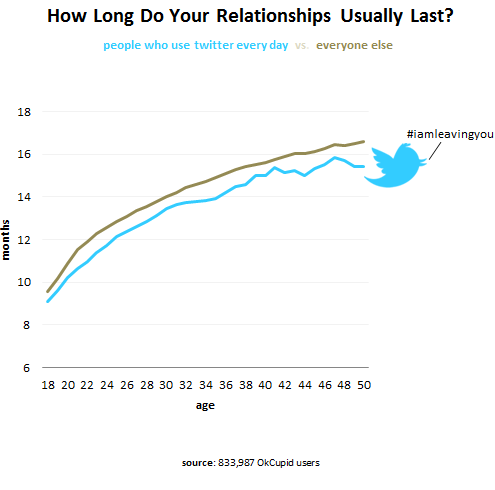
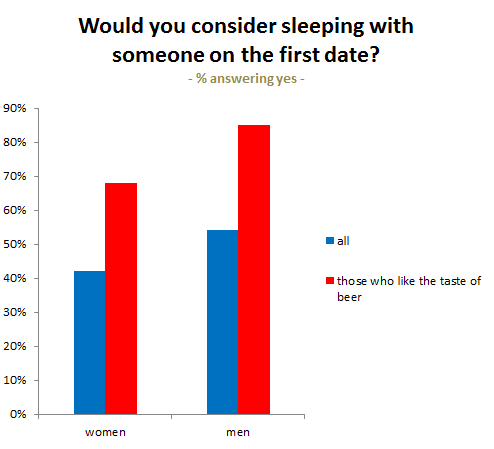

What does liking the taste of beer really have to do with your willingness to sleep with someone on the first date? If I start tweeting, does that mean that I have a higher chance of my boyfriend breaking up with me? Trends don't necessarily mean that one thing causes another. Going out and buying an iPhone won't guarantee that you'll suddenly get laid (sorry). Correlation is not causation.
However, this doesn't mean that such trends should be ignored. Some of OkTrend's graphs analyze extremely well-related information, and the data received shows some pretty startling conclusions. Be able to see how the type of camera you use to take a picture of yourself affects your overall attractiveness is pretty interesting. But, not only did I learn that I probably shouldn't snap a selfie with my phone if I want to look hot, I also learned that there's more to think about in terms of what kind of communication is being done through electronic media. Just like different cameras and the messages they send, there is more to new trends and changes than having them simply come about because of Instant Messaging or Wikipedia. We are human beings. Our brains consist of over 100 billion neurons and each is being affected new sources of media almost every day. We have to give ourselves a little more credit than that.

But not that much credit, Nevada.

Friday, September 27, 2013
Virtual Groups
One of the benefits of sleeping near my desk is that the moment I open my still sleep-heavy eyes (or at least attempt to), I only have to roll over to be able to access my laptop. It's a painful struggle to fumble for my mouse and push the green "call" button, but once I successfully do so, Skype rewards me with the voice of my boyfriend. "Good morning!" He's all too cheerful at such an hour for my taste, but that's because, for him, rather than it being a disgusting 8 am, it's five in the afternoon, and he's in the middle of a game.
The internet is an amazing place. Halfway across the world, halfway across the street, the internet brings people together regardless of their location. And I now realize it more than ever. Ten years ago, hoping to continue a relationship while a significant other traveled meant writing letter after letter, and waiting weeks before receiving a reply. Now, with my boyfriend a world away in Munich, sites like Facebook let me post terrible jokes instantly to his wall, and calling him on Skype is a perfect excuse to pretend he's present. We often get together and screen-share movies, or play games. Today, however, he's already in a game with a friend. As I listen to their banter, I am reminded of Walther and Bunz's article on virtual groups. According to Walther and Bunz, virtual groups "are groups in which interdependent members collaborate from different locations using communication technology". This group can emerge from the workplace, a social circle, or, like in the case of my boyfriend and his friend, an online gaming community.
At the start of the game, the two of them are paired with three random people from around the world, and spend the most part of 45 minutes trying to work together to accomplish one goal: to win. Winning relied on a number of things: communication, superior planning, and thorough execution. That is, to win, one team had to fulfill more of Walther and Bunz' "rules" of virtual teams than the other. Getting started right away, multitasking-- these were integral parts of a cohesive team, one that would use these strengths to come out on top. And the more I thought about it, the more I realized that these "rules" applied not only to the "virtual team" that was a gaming group, but also to the "virtual team" that was a long-distance relationship. In a sense, my boyfriend and I are "collaborating from different locations using communication technology" to achieve the common goal of continuing our relationship while apart. Facing a distance is a lot like facing an opposing team-- they're both hurdles that can be successfully overcome using Walther and Bunz's "rules." The stark contrast that is the lack of face to face interaction could be lessened with Rule 2, more frequent communication. Misunderstandings that are heightened by a largely impersonal medium could be avoided by Rule 5, being explicit about what you are thinking and doing. And planning for future conversations regardless of the time difference could be accomplished by Rule 6, setting deadlines and sticking to them.
That morning, my boyfriend won his game. And I felt like I won by learning a lesson in the game of love.
Subscribe to:
Posts (Atom)