Change is frightening. To have a comfortability overturned or a routine broken leaves a person with an uncertainty for the future. Change is inevitable, but often times change is not planned for. And this is why the world seems to be obsessed with change. This is why, although there is a "why," and even a "how," most of the world screams "what." There is a need to know what is causing change so that it can be prevented or reacted to accordingly-- so that the future can be planned for; so that the uncertain can once again become certain.
Many observations on the growth of various media are rooted in this idea of change. Google "has made us lazy." Texting has "weakened our social skills." Electronics have changed the way we work-- but often times those who are making such statements fail to remember that we were the ones who had created this media in the first place. If a new medium was made, there must have been a need. And if there was suddenly a need, it must have been due to a change within ourselves.
It's easy to give a concise reason to a large and pressing issue. However, often times these are false causes. There is an important phrase in psychology: correlation is not causation. And this is true with media. Humans are complex. Just because there seems to be a change in our nature during a period in which an electronic medium is prevalent does not mean that all changes are due to this medium. It's a difficult concept to grasp, but the hilarious blog, OkTrends, has managed to explain it perfectly. It uses information gathered on the online dating site, OKCupid, and creates graphs based on certain demographics, such as a country's per capita GDP and the percentage of people in that country that are looking for casual sex. Hilarity ensues, but so does a little bit of thinking, because not all of the things being compared even remotely relate to one another, yet they look very much like they do.
Take these graphs, for example:
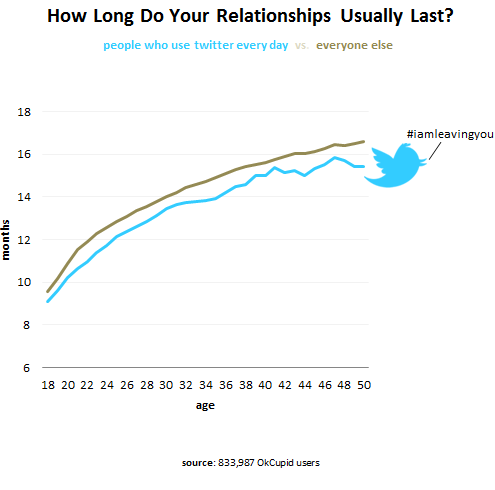
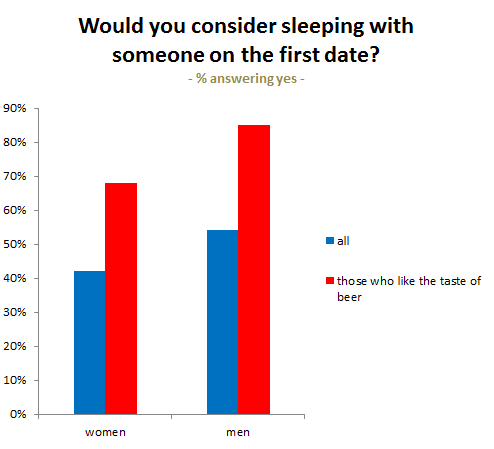

What does liking the taste of beer really have to do with your willingness to sleep with someone on the first date? If I start tweeting, does that mean that I have a higher chance of my boyfriend breaking up with me? Trends don't necessarily mean that one thing causes another. Going out and buying an iPhone won't guarantee that you'll suddenly get laid (sorry). Correlation is not causation.
However, this doesn't mean that such trends should be ignored. Some of OkTrend's graphs analyze extremely well-related information, and the data received shows some pretty startling conclusions. Be able to see how the type of camera you use to take a picture of yourself affects your overall attractiveness is pretty interesting. But, not only did I learn that I probably shouldn't snap a selfie with my phone if I want to look hot, I also learned that there's more to think about in terms of what kind of communication is being done through electronic media. Just like different cameras and the messages they send, there is more to new trends and changes than having them simply come about because of Instant Messaging or Wikipedia. We are human beings. Our brains consist of over 100 billion neurons and each is being affected new sources of media almost every day. We have to give ourselves a little more credit than that.
But not that much credit, Nevada.


No comments:
Post a Comment