Thursday, October 24, 2013

The Plays

As of this year, the United States government has decided to recognize video game players as professional athletes.

But what do video games have to do with sports?


Thousands of fans crowded in a venue, screaming and waving signs. Thousands of viewers watching from home. Broadcasters explaining strategies, analyzing replays. If you had to guess what sport the pros were playing, you'd most likely be wrong. There's no end zone. There's no home plate. There's only a mouse and a keyboard. This isn't sports-- this is eSports.

Thirty years ago, a team would have to meet on a field to practice. Today, they need only hop onto their computers. The internet has become a medium through which an individual from any corner of the world can transform into a player and a teammate. Each member may not necessarily be in the same physical location, but that doesn't change the way the competition works. Electronic sports, like the physical sports of football or baseball, require a dedicated team, complex strategic plays, and hours of practice a day. Teammates create a game plan, learn their opposing team's weaknesses, use tricks and skill to come out on top-- the same ideals are as crucial to an electronic team as they are to any other team. However, the internet allows team-based games to have an unprecedented reach across oceans and cultures, making competitive gaming the world's latest, and largest, pastime.

Competitive gaming got its start in the 1970s with a digital two-player game called Spacewar. Stanford University hosted a competition where students spent the day battling for the top score and a grand prize of a year's subscription to Rolling Stone. Later, in 1981, Atari held the earliest large scale video game competition for Space Invaders, attracting more than 10,000 participants across the United States. Fast forward to 2012. The popular game League of Legends is hosting its second world championships. The number of people who tuned in to watch: over 8 million. And the winning teams? Those players got to split a prize pool of two million dollars.

How did competitive gaming become so big? It's a little hard to say, as the interest in such games has only been around for 13 odd years and its numbers are still rapidly growing. More Americans play League of Legends, for example, than they play baseball-- Little League and Big League combined. In fact, there are currently 32 million League of Legends players, and 12 million of them play every single day. With the introduction of competitive strategy games like League and one of its most influential predecessors, Starcraft, the combination of online gaming's capabilities and the worldwide interest in such games translated itself into regional tournaments and international championships. In fact, where football has the NFL, eSports has the the MLG, Major League Gaming. Starcraft, League of Legends, Call of Duty-- teams that make their way to the professional level of their game attend yearly championships that are broadcast live to viewers all over the world. Teams spend an entire year practicing over 40 hours a week to improve in-game skills like time management, game mechanics, and team fights for their chance at a title of "the best in the game." Most teams even live together, practicing in the same space to better communication and interaction. Teams have their own official names, logos, uniforms, and sponsors. During the championships, broadcasters make comments on plays, interview the players, talk strategy, and show replays. Championships take place in convention centers filled with thousands of fans and even more game-related merchandise. Still, even though all of these elements mirror the sports culture, and professional gamers are making the same six-digit income that a professional football player is making, competitive gaming has been looked down upon and has been far from being considered a "sport."

Until now. In July of this year, the US government has acknowledged these things and has made a motion to recognize professional League of Legends players as "athletes." They will now award visas to international players to work in the United States under such a title. Major gaming companies struggled back and forth with the government until they were finally convinced that the game was a legitimate sport. This groundbreaking news will mean international recruitment will be easier and team growth will reach new horizons. With its new acceptance, and the game's growth, competitive gaming seems to soon be a household concept. Who knows, maybe in a few years we will all be sitting down with a bowl of chips to Sunday Night eSports. 

(P.S. Click through some of the links to play some Space Invaders & Spacewar!)


Watch this interesting video for more information on League of Legends:

Friday, October 4, 2013

iPhones & Sex: How Correlation Is Not Causation but Still Makes You Think


Change is frightening. To have a comfortability overturned or a routine broken leaves a person with an uncertainty for the future. Change is inevitable, but often times change is not planned for. And this is why the world seems to be obsessed with change. This is why, although there is a "why," and even a "how," most of the world screams "what." There is a need to know what is causing change so that it can be prevented or reacted to accordingly-- so that the future can be planned for; so that the uncertain can once again become certain.


Many observations on the growth of various media are rooted in this idea of change. Google "has made us lazy." Texting has "weakened our social skills."  Electronics have changed the way we work-- but often times those who are making such statements fail to remember that we were the ones who had created this media in the first place. If a new medium was made, there must have been a need. And if there was suddenly a need, it must have been due to a change within ourselves.


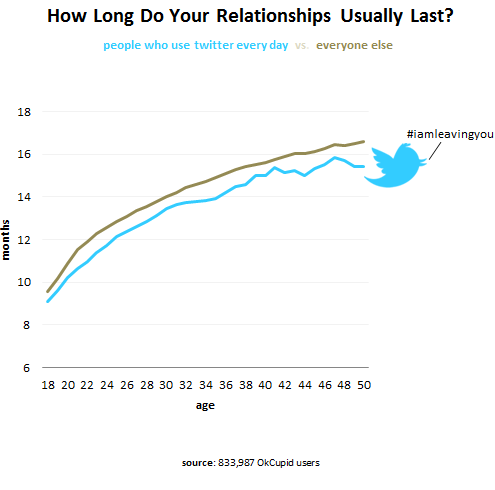
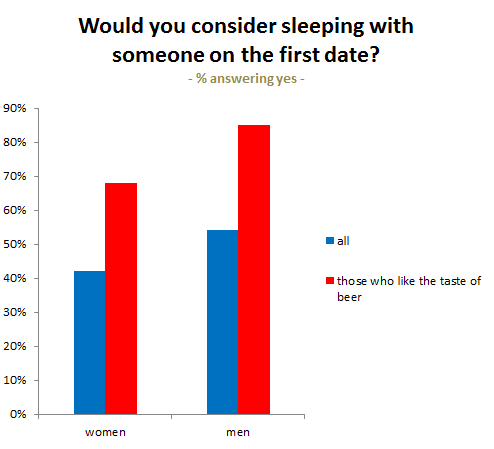
It's easy to give a concise reason to a large and pressing issue. However, often times these are false causes. There is an important phrase in psychology: correlation is not causation. And this is true with media. Humans are complex. Just because there seems to be a change in our nature during a period in which an electronic medium is prevalent does not mean that all changes are due to this medium. It's a difficult concept to grasp, but the hilarious blog, OkTrends, has managed to explain it perfectly. It uses information gathered on the online dating site, OKCupid, and creates graphs based on certain demographics, such as a country's per capita GDP and the percentage of people in that country that are looking for casual sex. Hilarity ensues, but so does a little bit of thinking, because not all of the things being compared even remotely relate to one another, yet they look very much like they do.


Take these graphs, for example:


What does liking the taste of beer really have to do with your willingness to sleep with someone on the first date? If I start tweeting, does that mean that I have a higher chance of my boyfriend breaking up with me? Trends don't necessarily mean that one thing causes another. Going out and buying an iPhone won't guarantee that you'll suddenly get laid (sorry). Correlation is not causation.

However, this doesn't mean that such trends should be ignored. Some of OkTrend's graphs analyze extremely well-related information, and the data received shows some pretty startling conclusions. Be able to see how the type of camera you use to take a picture of  yourself affects your overall attractiveness is pretty interesting. But, not only did I learn that I probably shouldn't snap a selfie with my phone if I want to look hot, I also learned that there's more to think about in terms of what kind of communication is being done through electronic media. Just like different cameras and the messages they send, there is more to new trends and changes than having them simply come about because of Instant Messaging or Wikipedia. We are human beings. Our brains consist of over 100 billion neurons and each is being affected new sources of media almost every day. We have to give ourselves a little more credit than that. 

But not that much credit, Nevada.